A Street Name Is Not a Full History
Learn how to investigate a street name by comparing its wording, dated records, and naming documents, then describe what the evidence supports.
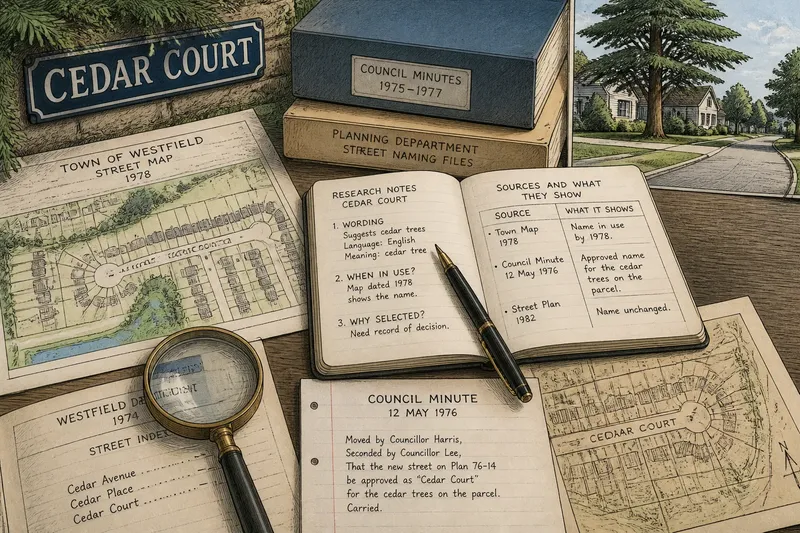
A street name can point toward a feature, person, or older word, but the name alone rarely explains why it was chosen. To investigate a street name, separate what its wording suggests from what dated records show and what an official naming document says.
Begin with the exact form of the street name
Write down the name as it appears on the sign, including its suffix: Lane, Road, Court, and Street may help distinguish places with similar names. Then note the municipality and nearby landmarks. Those details keep a search for “Mill Lane” from wandering into records for another town.
Look for earlier spellings in maps, directories, property plans, and local government files. A change from “Mylle Lane” to “Mill Lane,” for example, could reflect a spelling update, a clerk’s choice, or a change in how the name was understood. The sequence is a clue, not a verdict.
Keep three questions separate:
- What does the wording suggest? Consider the language and possible meanings of the name.
- When was the name in use? Look for dated documents that show the form appearing in print or on a map.
- Why was it selected? Seek a record of the naming decision or a source that directly connects the name to its proposed origin.
A street name is like a label on a file folder: it helps you find the question, but it does not contain the whole record.
Match each source to the question it can answer
A linguistic source can help assess whether a proposed meaning fits the word’s language or older forms. A historic map or street directory can show that a name was in use by the date of the document. Neither source necessarily explains the decision behind the name.
For that, look for municipal minutes, subdivision plans, planning files, or a street-naming application. A document that records the proposed name and its reason offers a more direct link than a map that merely prints the name. Check who created the record and what decision it actually documents.
- If an older map shows the name, treat it as evidence that the name was in use by then; look elsewhere for the reason it was chosen.
- If a council minute records a proposal and rationale, report that rationale as the documented reason; check whether a later decision changed the name.
- If an older spelling differs, preserve both forms and search for an intermediate record; do not assume the difference reveals the origin.
- If a directory omits the name, do not conclude that the street did not exist; check whether the directory covered that area or type of property.
- If two sources give different dates, compare what each dates—proposal, approval, publication, or first appearance—and describe the distinction.
- If a source makes a claim without showing its basis, label it as an unverified account and seek the document or citation it relies on.
Say you are investigating “Cedar Court,” and, for this invented example, imagine a town map dated 1978 labels the street while a council minute from 1976 records approval of the name “for the cedar trees on the parcel.” First, you copy the map’s spelling and date. Next, you locate the minute and check that it names the same street and gives that reason. Then you compare a later street plan to see whether the approved name was altered. Your supported account is that the council recorded the cedar trees as its reason in 1976 and the map shows the name in use by 1978; the documents do not establish whether trees stood there earlier unless they say so.
How do you check a street-name origin?
What does the earliest map prove?
It shows that the mapmaker used the name by the map’s date, assuming the map is correctly dated and identifies the location. It does not, on its own, show when the name was first proposed or why.
Where can you find a naming decision?
Start with the city or town clerk, planning department, local archives, and subdivision records. Search the street name alongside terms such as “naming,” “approval,” “plat,” or “council minutes,” then confirm that a result refers to the same place.
How should you handle conflicting dates?
Identify what each date describes: a proposal, formal approval, map publication, or first located appearance. If the records do not settle which came first, state the difference rather than selecting one date as the origin.
What if no direct record survives?
Describe the best-supported clue and name its limit: an older spelling may suggest a linguistic path, while a map establishes use by a certain date. Present a proposed origin as uncertain unless a source connects it to the naming choice.
Write the finding at the right level of certainty
Choose wording that matches the source. “A map dated 1978 shows Cedar Court” reports a dated appearance. “The council minute records the cedar trees as the reason for the name” reports a documented rationale. “The name may refer to cedar trees” is appropriate when the wording suggests that possibility but no naming record confirms it.
If records disagree, explain what each one says and what it dates. If you have only a map, do not turn its first appearance into a claim about the street’s creation. That distinction makes the account clearer and leaves room for a future document to sharpen the story.
For a street-name origin, the most useful next search is usually not another retelling of the same explanation but the record closest to the naming decision. A clerk’s file, planning attachment, or original subdivision plan may show whether the familiar explanation was written down when the name was selected—or whether it remains a plausible interpretation.