A Three-Stop Neighborhood Walk for Noticing Local Life
Plan a three-stop neighborhood walk to notice local routines, public information, and shared landmarks while keeping your observations grounded in what you see.
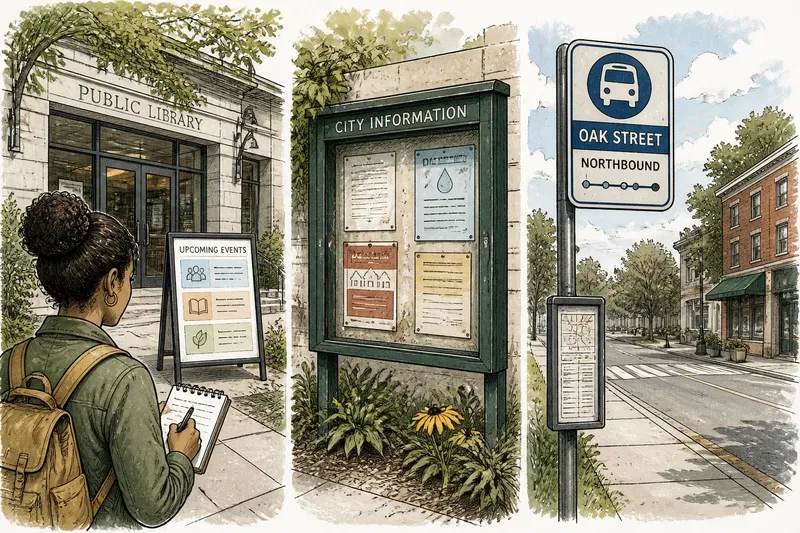
A three-stop neighborhood walk can reveal how local routines, public information, and familiar landmarks meet in one small area. Choose a community gathering spot, a public-facing notice, and a place people use for directions; the contrast gives each stop a distinct purpose.
The walk is not a survey of everyone who lives nearby. It is a way to notice what a place makes visible, and to keep observation separate from assumptions about who belongs or what a feature means.
Choose three stops with different civic roles
Begin with a place where neighbors can gather or take part in local life: a library entrance, a community garden, a recreation-center lobby open to visitors, or a public plaza. Look for features that support a specific activity, such as a posted event schedule, a clearly marked entrance, or a table set aside for community information. These details describe the setup; they do not tell you who uses it or how they feel about it.
For the second stop, choose public information intended for people in the area. A library event calendar, a city-service announcement case, or a community-center program flyer can show what information is being offered and where. Read what is openly displayed, and leave personal names or contact details out of your notes.
Make the third stop a place that helps people orient themselves: a named bus stop, a public library sign, a street-name sign, or a map at a trail entrance. Notice what makes it useful as a reference, such as a clear name, a visible symbol, or its position beside a recognizable intersection. The purpose is to see how the area identifies places, not to infer a shared story from one sign.
Choose stops that can be visited in a comfortable sequence. Think of them like three objects on a desk: each has a different use, and space between them makes those differences easier to see.
Shape the walk around civic connections
Rather than treating the stops as isolated attractions, consider how someone might move between places where information, services, and orientation meet. A library calendar may point to a community program, while a bus-stop name may help visitors locate the building. Those are visible connections; they do not establish how often people use the service or what they think of it.
Check whether each stop is publicly accessible and whether the route crosses private property or enters a building with restricted access. If a planned stop is inside a closed facility, substitute an outdoor public notice or another accessible civic marker. Respect posted rules and avoid recording private conversations or personal information.
Say you begin at a public library entrance, where a display lists a neighborhood meeting, and plan to finish at a named bus stop nearby. Imagine the entrance is closed for a scheduled event that visitors cannot attend. You could instead read an outdoor city-service notice on the same block, then use the bus-stop name as the final reference point; the resulting route still connects public information with a place that helps people orient themselves, without entering a restricted event.
Record what each stop can and cannot tell you
At the gathering place, describe the service or activity the space appears set up to support. At the notice, record its subject and where it is posted, without copying private details. At the orientation point, note its name or visible marker and what nearby feature helps identify it.
Use a simple observation-and-decision checklist. For every item, the observation should guide a practical choice, not a broad claim about the neighborhood:
- Access: Check whether the stop is clearly open to the public; if it is, include it, and if access is unclear or restricted, choose an outdoor alternative.
- Purpose: Check whether a sign or layout identifies a civic use; if the purpose is visible, describe that function, and if it is not, record the uncertainty instead of assigning one.
- Information: Check whether a notice is readable and intended for public viewing; if it is, note its topic, and if it is blank, private, or unreadable, move to another public source.
- Orientation: Check whether a name, map, or marker helps identify a location; if it does, use that feature as your reference point, and if it does not, select a clearer public marker.
- Privacy: Check whether your notes or images would identify a passerby or expose personal details; if they would, leave those details out, and if the scene cannot be framed respectfully, do not photograph it.
- Uncertainty: Check whether a statement describes something directly visible; if it does, keep it, and if it guesses at residents’ motives or feelings, rewrite it as a question or omit it.
For instance, imagine your starting notes say that a library entrance has a public event calendar, a nearby service notice is faded, and the bus-stop sign has a legible name. You first record the calendar’s topic without listing attendees, then look for a clearer public copy of the service notice; if none is available, you mark it unreadable rather than guessing at its contents. Finally, you use the bus-stop name as the route’s reference point. The finished account can say that the library displayed an event calendar and the stop had a readable name, while the service notice could not be read; it cannot say how many people attend or whether neighbors value the event.
What should you do when a stop is unavailable?
What if the civic space is closed?
Choose another publicly accessible place connected to local services or community activity, such as an outdoor library drop box area or a public information kiosk. If no suitable alternative is nearby, keep the other stops and note that the intended space was not accessible during your visit.
What if the notice is blank or unreadable?
Look for another public-facing source, such as a city bulletin case or a library display. If none is readable, record that limitation and avoid treating the absence of a notice as evidence that local communication does not happen.
How can you tell whether a marker is useful?
Check whether its name, map, or symbol identifies a location in a way a visitor could follow. If the marker is unclear, use a nearby street sign or public transit stop as a more precise reference.
What should you include in your notes?
Write down visible details, the source of public information, and anything you could not verify. Leave out identifiable people, private contact details, and claims about what residents think unless someone has chosen to share that context with you.
Keep the account grounded in visible details
Compare the stops by their different civic functions: one may offer a place for community activity, another may display public information, and a third may help people locate themselves. Describe each function narrowly. A posted meeting notice shows that an invitation is displayed; it does not show who will attend or how the invitation will be received.
A useful note might read, “The library entrance displays an event calendar; the service notice is too faded to read; the bus stop has a clear name sign.” That sentence separates what is visible from what remains unknown. It is more useful than claiming the stops reveal what the whole neighborhood believes or needs.
To make a neighborhood walk more informative, choose stops that show different parts of local civic life and let the evidence set the limits of your account. The same route can be revisited when public notices change, giving you a fresh record of what is available without turning one visit into a verdict about the people who live there.